


App limits
App time limits: how to give YouTube or a game its own daily allowance
Hami Team6 min read
 Hami Team6 min read
Conditional time is a rule that lets an app open only after a set amount of time has been spent in another app. In Hami it reads like this: when your child spends 20 minutes in a reading app, the game opens for 30 minutes; the rule can repeat each time or run once a day. The total daily limit still applies. On Android you set it from your own phone; on an iPhone, from the parent settings on the child's iPhone.
It is a way of having the phone say "homework first, then games" so you do not have to say it every day.
Rules that only restrict leave a child with one message: the phone is bad. Conditional time says something different: there are good things to do on the phone, and they open the door to the fun ones. For a nine-year-old, "half an hour in the book app, then half an hour of the game" is a deal that feels understandable and fair. Better still, the bargaining moves from you to the rule. The child watches the counter fill up instead of working on you.
Turning everything into a transaction is not a good idea either. Tying the pleasure of reading to a reward can backfire. Most families use this for one or two apps and for a period: until a new language app becomes a habit, or to keep homework going over the holidays.
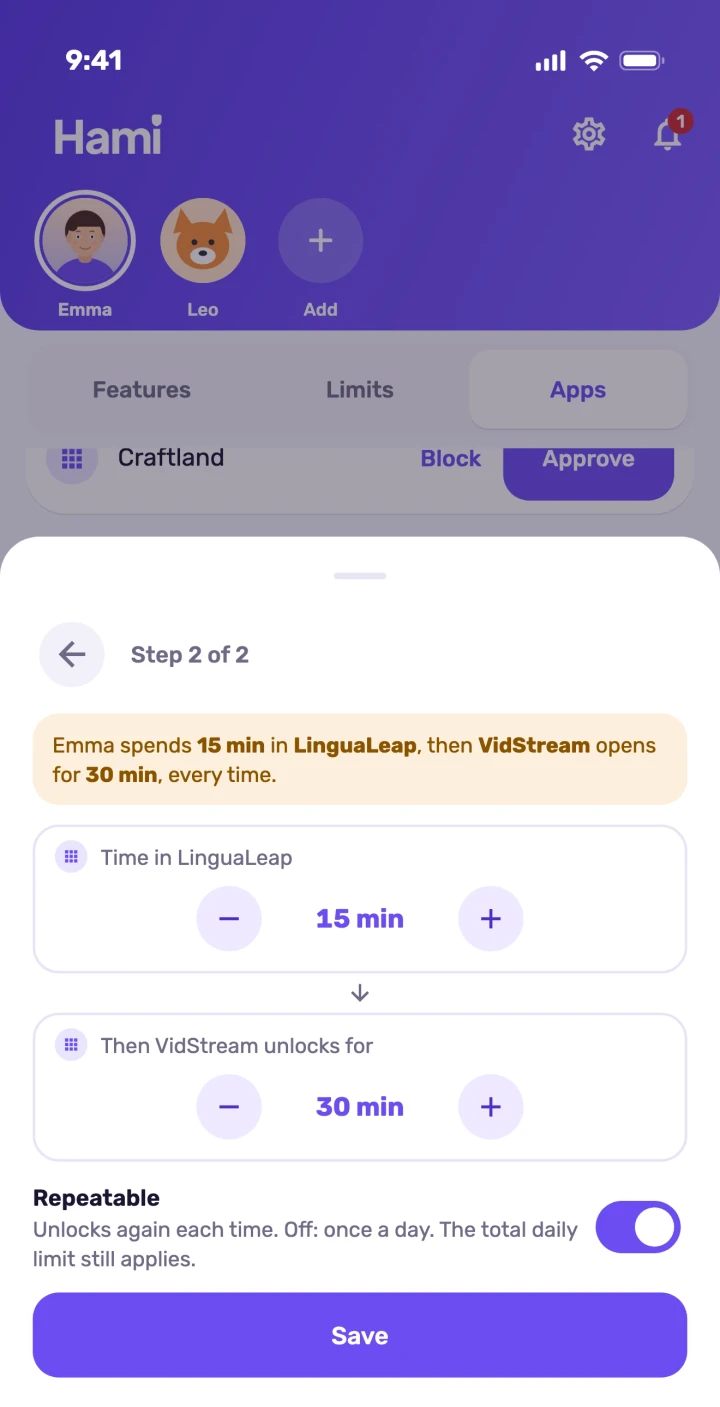
It has three parts:
Then there is the Repeatable switch. On, every 20 minutes of reading earns another 30 minutes; off, the rule runs once a day. In both cases the total daily limit sits on top: if the child has finished the day's time, earned minutes cannot be used that day. Earned time resets at midnight.
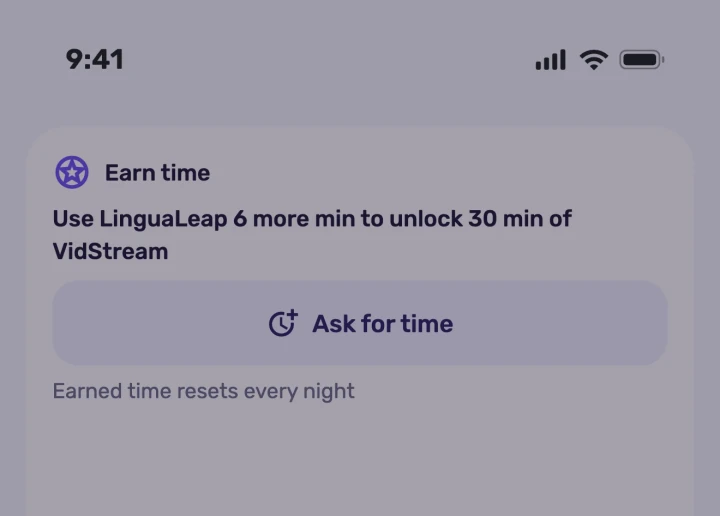
If the child tries to open the reward app before the condition is met, it appears locked and the lock screen says why. When the condition is met, the child gets a "+30 min unlocked" notification, and a "2 minutes left" warning near the end.
On Android, open Rules, then Apps in Hami, tap the reward app, choose Conditional time, pick the earning app, set the two amounts of minutes and, if you like, switch on Repeatable. A summary sentence ("Ali spends 20 min in Reading, then Game opens for 30 min, every time") confirms the rule. On the child's phone, Hami Kids shows an Earned time card with what was earned, what is left and when it resets. If the child leaves the earning app open without touching the screen, earning pauses.
On an iPhone, the rule has the same name but is set on the child's iPhone from the parent settings in Hami Kids, with Apple's picker for both apps; exactly one app can be chosen for each side. Two limits to know: the iPhone counts time in 5-minute steps, so a 20-minute condition is met somewhere between 20 and 25 minutes, and an iPhone cannot tell whether an open app is in use. That is Apple's design. The other differences are in the iPhone guide.
The screen-by-screen steps for both platforms are in step by step: app time limits and conditional time in Hami.
Technically the rule accepts almost any app, apart from blocked, always-allowed and waiting ones. In practice the ones that work are apps the child actually does something in: reading, maths and language apps, coding, instrument practice. The ones that do not are "just leave it open" apps: a music player, a notes app, a passively watched video channel. Android pauses earning when the screen is not touched, but watching a video needs no touching either, so think twice before putting a video app on the earning side. Age matters too: at seven or eight even ten-minute conditions feel long; from twelve, twenty to thirty minutes sits comfortably.
Choose a learning app your child already uses a little and tie it to the game they play most, starting with a small trade such as 15 minutes for 20. The screen-by-screen steps are in the step-by-step guide. For the daily-battle side, see game time without the daily battle. If Hami is not set up yet, the 5-minute setup is enough.
A rule that lets one app open only after a set amount of time has been spent in another app. For example, 20 minutes in a reading app unlocks a game for 30 minutes. You can make it repeatable or once a day.
No. Conditional time works inside the total daily limit. If the child has used up the day's time, earned minutes cannot be used that day; Hami Kids says so plainly.
On Android, Hami Kids notices when the screen is not being touched and pauses earning; the child is told to tap to continue. On an iPhone, Apple counts time in 5-minute steps and cannot tell whether an open app is actually being used.
Yes, under the same name, Conditional time. The rule is set on the child's iPhone from the parent settings in Hami Kids: pick the reward app, choose Conditional time and Continue, then pick the earning app and the minutes.
No. Earned time resets every night; the child earns again the next day.
App limits
Hami Team6 min read

App limits
Hami Team5 min read

iPhone
Hami Team5 min read
Set it up in about five minutes. Your child can always see which rules are on.