
App time limits: how to give YouTube or a game its own daily allowance
7 min read
To put a daily time limit on a single app on your child's phone, you choose that app in Hami and give it a "Time limit" rule, for example 30 minutes a day for YouTube. When the time is up, only that app locks; the rest of the phone keeps working. On Android you do this from your own phone. On an iPhone, the app is chosen on the child's iPhone, because that is where Apple allows it.
A total screen time limit is most families' first rule. Then at some point you hear the same line: "I was using it for homework anyway." And the two hours turn out to have been one hour and forty minutes of YouTube. Per-app limits exist for exactly that moment.
When a per-app limit beats a total
It helps to think of three tools together:
- Daily total limit: the frame for the whole day. The phone, at most this much.
- Per-app time limit: stops one or two apps from swallowing the day. Two hours in total, but YouTube is at most 30 minutes of it.
- Block: the app never opens. For a game that is not age-appropriate, or a social network you no longer want.
Most families run the first two together: a reasonable total, plus a limit of its own on the one or two apps that take the most time. The daily limit article covers the first; this one is about the second.
Setting a per-app limit on Android
- In Hami, choose your child, open Rules, then Apps. The apps on the child's phone are listed, most-used first, with a search box.
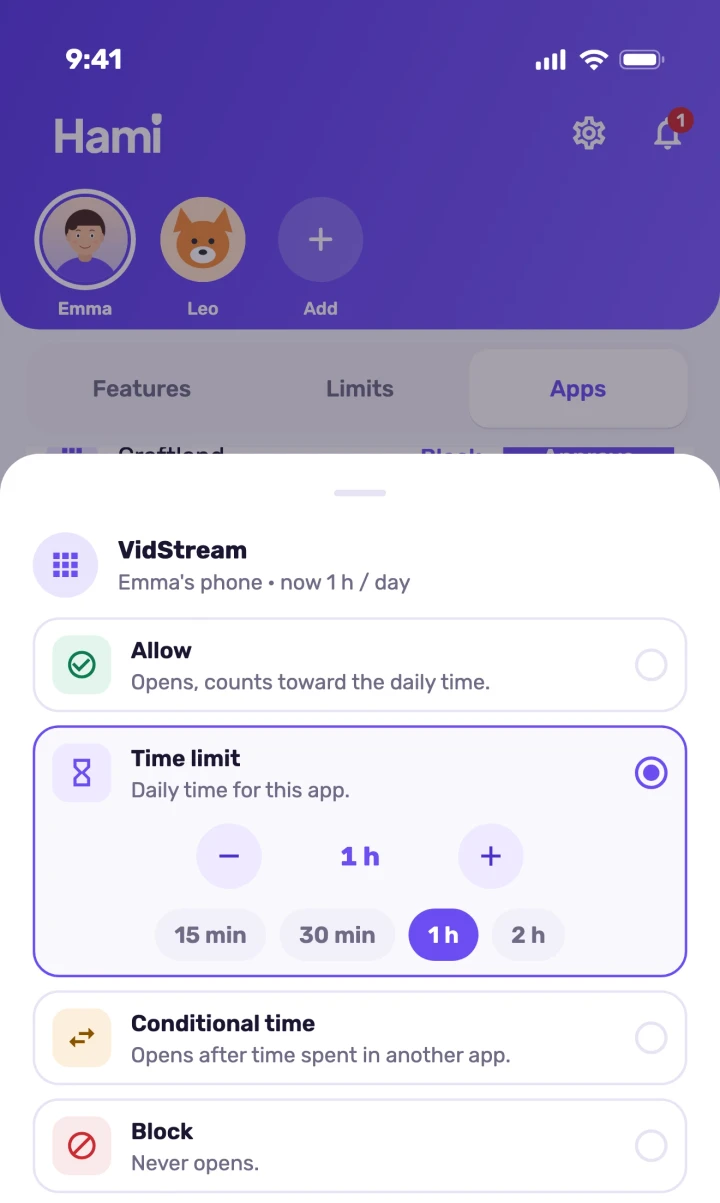
- Tap the app. Four options appear: Allow, Time limit, Conditional time, Block.
- Choose Time limit. The amount opens in the same sheet: use the 15 min, 30 min, 1 h and 2 h presets or the plus and minus buttons to set the daily time.
- Tap Save. The rule reaches the child's phone immediately.
Apps with a rule show up in their own group with a label such as "30 min / day", and today's usage next to it, like "22 min today". If one app took most of the week, the weekly report suggests "Set a 45 min limit for X", which you can apply with one tap.
When the time is up and the child tries to open the app, the Hami Kids lock screen says why. The child can send you a request for more time.
Setting a per-app limit on iPhone
It works on iPhone too, but the route is different, because Apple does not let third-party apps see or manage other apps remotely. Apps are chosen on the child's iPhone, in Apple's own picker. It takes about a minute:
- Take your child's iPhone and open Hami Kids.
- Tap the Parent button at the top (the lock icon) and enter your parent PIN.
- Under "App rules on this iPhone", tap Choose an app to add a rule. Apple's picker opens; tick the app or a category and confirm.
- Tap the app in the list, choose Time limit in the rule sheet, set the time and tap Save. The iPhone applies the rule right away. Hami on your own phone updates with the next sync, usually within a few minutes.
Two things to be honest about. Apple keeps app names on the iPhone; Hami only sees how many apps and categories were chosen, not which ones. And when a limit is reached, the lock screen can keep showing an earlier reason until the app is restarted; what is locked is always correct. All of these limits are listed in What parental controls can do on an iPhone.
Category lock: all games at once
On Android you can lock a whole category instead of picking apps one by one: games, social media, video. Every app in a locked category is blocked, and a newly installed game falls under the same rule automatically. Handy for switching games off during the school week and back on at the weekend.
There is no category lock on iPhone. You can tick a category in Apple's picker and give it a time limit, but that is giving a category time, not locking it.
Two mistakes worth avoiding
Limiting too many apps at once. With five or six apps on separate clocks, neither the child nor you can follow what closes when. Two or three limits plus the daily total is enough; on Android the category lock covers the rest.
Forgetting the browser. A limit on the YouTube app does not stop the same video opening in a browser. On Android, give the browser a limit too or block the site in web protection; on an iPhone the browser may need a rule of its own, and the blocked-sites list in web protection helps too (see the web protection article).
How much time is reasonable?
It depends on what the app is for. Thirty to forty-five minutes for YouTube is a common choice; thirty minutes to an hour for a game. Measuring for a week before deciding helps: Hami's app list shows how long each app was used today, and the weekly report shows the week's total.
Talk the limit through with your child. When you say "YouTube is half an hour a day", your child sees it as an open rule in Hami Kids and is not caught by surprise. The argument becomes about the amount, not about the existence of the rule. That is a healthy argument to have.
Next step
Find the one app that takes the most time in your child's app list and give it a limit. Check a week later: did total screen time drop, or did another app take its place? If you would rather tie a reading or learning app to game time, conditional time does exactly that. The screen-by-screen steps are in the app time limits and conditional time guide.
Frequently asked questions
Can I limit only YouTube?
Yes. In Hami you pick YouTube from your child's app list and give it a Time limit, say 30 minutes a day. When it runs out only YouTube locks; the rest of the phone keeps working.
Do per-app limits work on an iPhone?
They do, but Apple only allows apps to be chosen on the child's iPhone itself. You open the parent settings in Hami Kids with your parent PIN, pick the app in Apple's picker and set the time. Hami does not see the app's name, only how many rules exist.
What is the difference between a time limit and blocking?
Blocking means the app never opens. A time limit opens it for a set time each day, then locks it. Conditional time opens it only after time has been spent in another app.
Can I limit a whole category, like all games?
On Android there is a category lock: every app in a category such as games or social media is blocked. On an iPhone you can pick a category in Apple's picker and give it a time limit, but the category lock itself is Android-only.
Keep reading
- How to set a daily screen time limit on your child's phone (Android and iPhone)
What a daily screen time limit does and does not do, how it works on Android and iPhone, what the child sees when time runs out, and how requests for more time are handled.
- Conditional time: let minutes in a reading app turn into game time
With a conditional time rule the child spends X minutes in a learning app first, then the game you chose opens for Y minutes. The logic, setup on Android and iPhone, and the pitfalls.
- What parental controls can do on an iPhone (and what they can't)
What a parental control app can and cannot do on an iPhone, because of Apple’s Screen Time API, and how Hami works within it.
- How to set app time limits and conditional time
How to set a daily time limit on a single app and set up conditional time in Hami: from your own phone on Android, from the parent settings on the child’s iPhone, step by step.
Download Hami
Set it up in about five minutes. Your child can always see which rules are on.