


Transparency & trust
Transparent parental control versus secret monitoring: why your child should know
Hami Team7 min read
 Hami Team7 min read
Tell your child before you turn parental controls on, in a calm conversation with the reasons ready, and show them exactly what you can and cannot see. That is the whole recipe. Most fights about phone rules are not about the rule; they are about finding out that it existed. This guide gives you a five-step conversation, sample sentences for three age bands and answers to the hardest question a child asks: "Don't you trust me?"
Hidden controls are found. A twelve-year-old who notices an unfamiliar app or a battery drain will look it up, and the question changes from "why is there a time limit?" to "why did you hide it?". The longer version of this argument is in transparent parental control versus secret monitoring; the short version is that you cannot ask a child for honesty while being secretive yourself.
Telling also changes the rule's meaning. A limit the child knows about is a family rule. A limit the child discovers is a trap. Children keep rules they understand much more reliably than rules they have to work around.
Do the homework first, alone or with your partner:
Keep it short. Twenty minutes with a snack beats an hour at the table.
This is the hardest moment and it deserves a straight answer. Something like: "I do trust you. I do not trust the internet and I do not trust that every app is built to let you stop. These rules are about the apps, not about you. And when you show you can handle more, the rules will loosen."
Then do what you said. Trust that is promised and not returned costs more than any limit. If you made a promise to loosen the rules at the next review, keep the date.
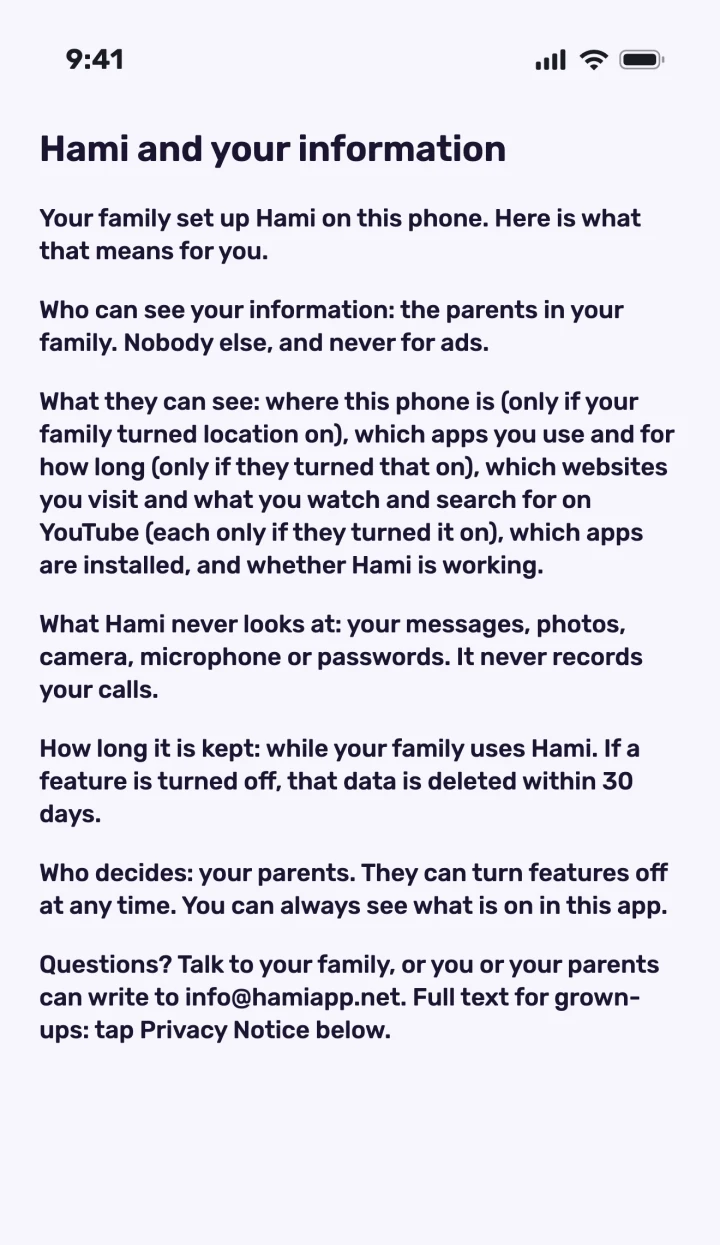
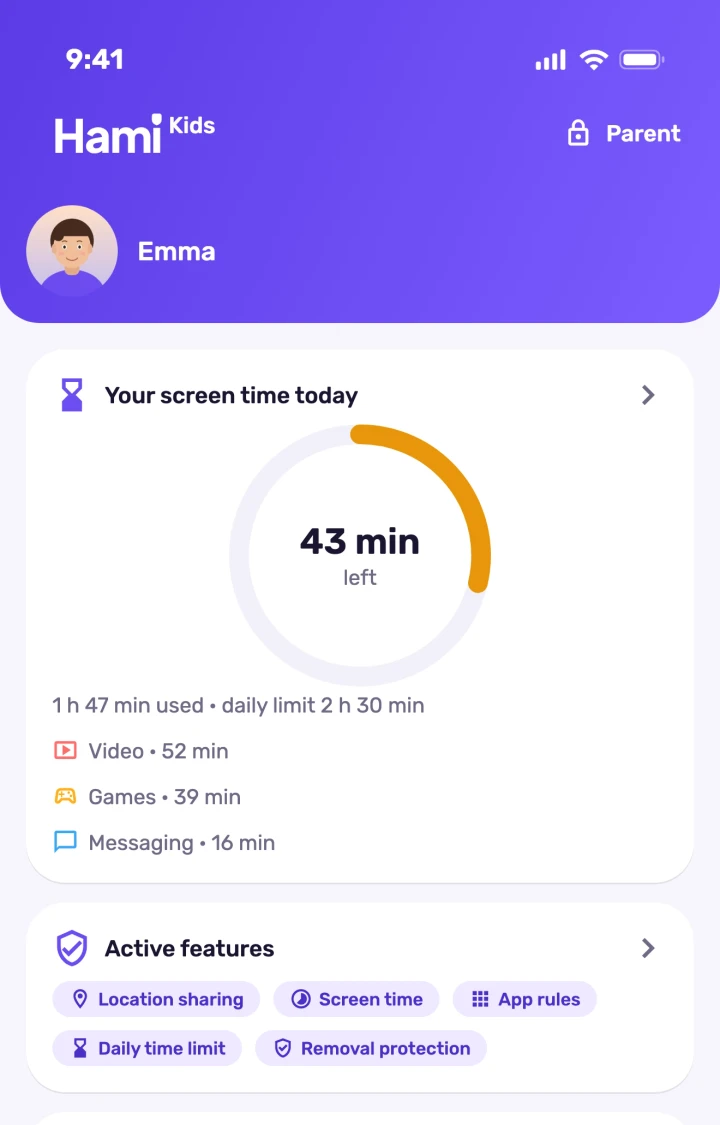
Describing what an app can see invites worst-case imagining. Opening the screen together ends it. In Hami, your child can open Hami Kids on their own phone at any time and read a screen called "What my parent can see". It lists, in plain words, what is shared (for example where the phone is, how long and in which apps it is used, and that limits can be set) and says that your family manages the phone. Doing this together on day one removes the guessing.
Say at the start that the rules are not forever, and then show it. A child who earns a later bedtime by keeping the current one learns the lesson you meant to teach. Loosen one thing at a time, tell your child what you changed and why, and keep what matters most: sleep, strangers, and an honest list of what you can see. See a family phone agreement your child will actually keep for a written way to do the reviews.
Hami was built for this order of events: the child knows. Hami Kids has a visible icon and, on Android, a persistent notification. It never reads messages, never uses the microphone, never records the screen and uses the camera only to scan the optional pairing QR code. If you use Hami, do the setup together; the child's phone shows what is turned on while you do it. For a tour of that screen, see what your child sees in Hami Kids.
Write your three rules and three reasons, decide what you can see, and pick a calm moment this week. Open the app together, ask what feels unfair and change one thing. Then put the review date in the calendar.
From the first day the rules exist. Even a six-year-old can understand 'the phone sleeps at night and Mum can see which games you play'. What changes with age is the depth of the explanation, not whether you give one.
Anger is normal and usually means the rule matters to them. Name it, keep the rule, and offer a concrete moment to talk again, such as the next review. Do not remove the rule in the heat of the talk, and do not hide it afterwards.
Yes, including what it cannot do. Teenagers check. If they find something you did not mention, the damage is larger than any rule. In Hami the child can read the list themselves on their own phone.
No, but say so soon. Admit it plainly, explain why you did it, show what you can see and offer to change something in return. Trust recovers faster from an honest correction than from being found out.
Transparency & trust
Hami Team7 min read

Family rules
Hami Team8 min read

Family rules
Hami Team7 min read
Set it up in about five minutes. Your child can always see which rules are on.